
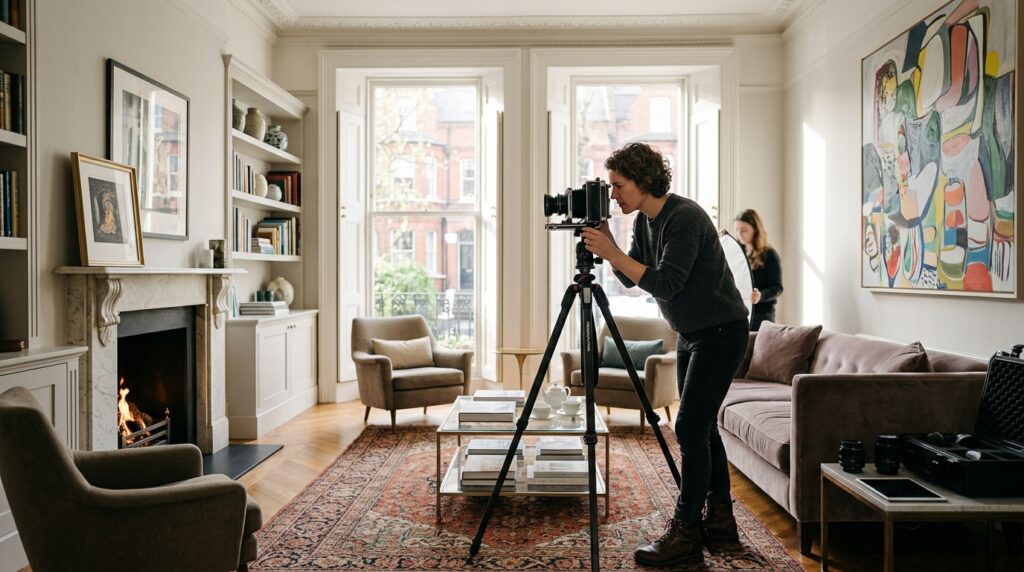
Finding the right interior photographer in London is not simply a matter of searching for the cheapest available option or the most prominent name in a Google result. The interior photography market in London spans a wide range of specialisations, experience levels, and pricing structures. A photographer who produces outstanding work for residential property sales may not be the right choice for a hotel group repositioning its brand. A photographer with a strong commercial advertising portfolio may approach an architectural documentation brief with a style that serves neither the architect nor the building. Getting this match right from the start determines whether the images produced are assets that actively work for the project, or photographs that document a space without communicating anything meaningful about it.
This guide is written for architects, property developers, hotel marketing managers, restaurant groups, interior designers, and residential clients commissioning interior photography in London for the first time or reviewing their current approach. It covers the categories of interior photographer working in London, what to look for in a portfolio, how to write a brief that produces the right images, what a professional commission costs, and the questions worth asking before booking.
Why Interior Photography in London Is a Commercial Decision, Not a Creative One
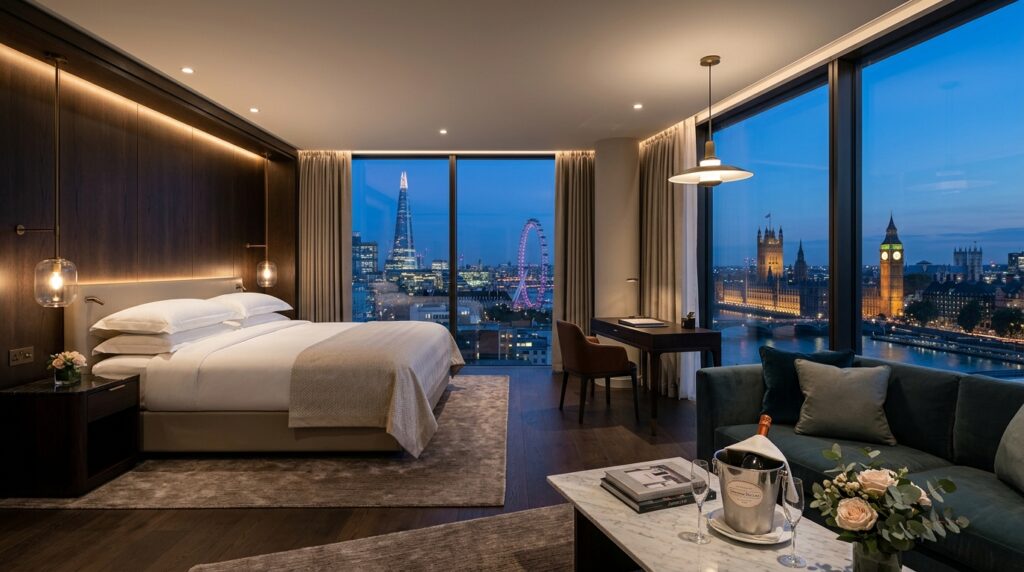
Before evaluating individual photographers, it is worth understanding what interior photography actually delivers commercially. The case for professional photography is well established across every sector that commissions it.
A peer-reviewed study published in Humanities and Social Sciences Communications (2023) found that the human brain processes visual information 60,000 times faster than text, and that photographic images help customers perceive product information more accurately and clearly. [1] In a property or hospitality context, this means a prospective buyer or guest forms a strong initial judgement about a space before reading a single word of descriptive copy.
The commercial implications are measurable. According to data compiled by PhotoUp from NAR and industry sources (2025), listings with professional photographs generate 118 percent more online views, sell 32 percent faster, and attract a 47 percent higher premium per square foot compared to listings without professional photography. [2]
For hospitality, the numbers are equally clear. Research published in Annals of Tourism Research (2025) established that hotel cover photography functions as a critical visual heuristic in booking decisions on online travel platforms, significantly influencing whether prospective guests click through to view a property in detail. [3] Industry analysis by AB Photo Video found that hotels with professional photography see a 5 to 15 percent improvement in direct booking conversion rates, while properties with generic or poor photography typically see average daily rates 10 to 20 percent lower than comparable properties with professional imagery.
These figures make the decision to commission an interior photographer in London a financial one rather than an aesthetic preference. The question is not whether to invest in professional photography. It is which photographer is right for the specific project.
The Different Types of Interior Photographer Working in London
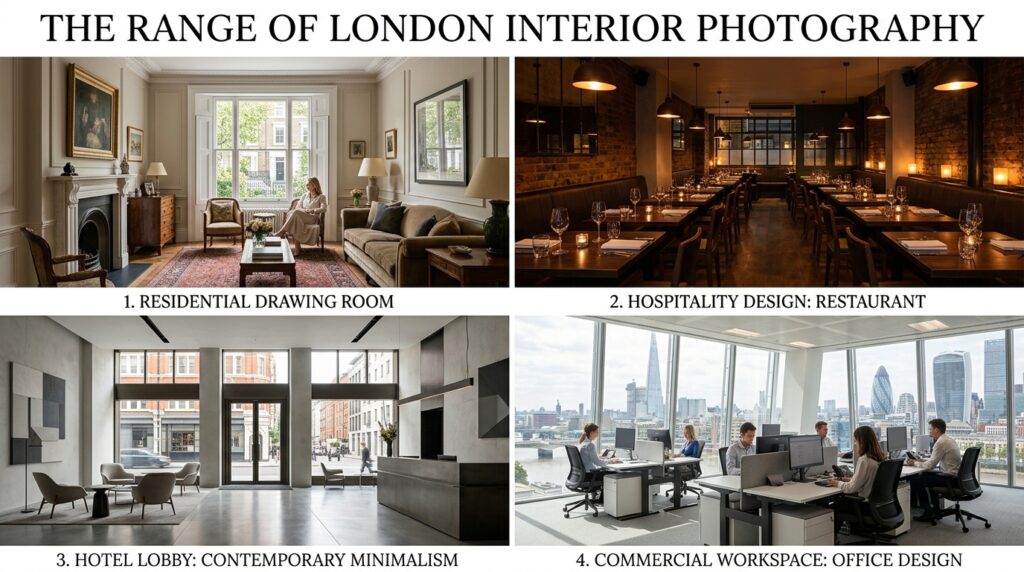
London has a large pool of photographers who describe themselves as interior photographers. The term covers significant variation in specialisation, approach, and the intended use of the images produced. Understanding these distinctions before approaching photographers will save significant time in the evaluation process.
Residential property photographers
Residential property photographers work primarily for estate agents, residential developers, and private sellers. Their priority is communicating the size, light, and condition of a property quickly and accurately for online listing portals. The approach emphasises wide-angle coverage, fast turnaround, and a consistent look across many rooms. This category of photographer is often the most affordable option in London and typically works at speed across multiple properties per day. They are the right choice for residential sales and lettings photography where the primary distribution channel is Rightmove, Zoopla, or similar portals. They are generally not the right choice for architectural documentation, hotel repositioning campaigns, or design-led residential projects where the photography needs to communicate quality, atmosphere, and brand positioning.
Architectural and design documentation photographers
Architectural and design photographers work primarily for architects, interior designers, developers, and manufacturers. Their priority is communicating the spatial, material, and design qualities of a completed project accurately and compellingly for use in award submissions, press coverage, design publications, and professional portfolios. This category requires a thorough understanding of architectural space, light control at a technical level, and the patience to work slowly with a view camera or tilt-shift lens to correct perspective distortion accurately. These photographers are the right choice for any project where the work of the architect or designer is the subject of the photography, and where the images will be submitted to design press or entered into competitions.
Hospitality and hotel photographers
Hotel and hospitality photographers work primarily for hotel groups, restaurant chains, serviced apartment operators, and hospitality brands. Their priority is communicating atmosphere, experiential quality, and brand positioning to prospective guests making booking decisions online. This category requires the ability to work with ambient and architectural lighting to create images that feel lived-in and aspirational rather than empty and clinical, and to balance the technical demands of interior photography with the commercial requirements of hospitality marketing. For hotel and restaurant clients in London, finding a photographer with a specific hospitality portfolio is significantly more important than finding the cheapest available interior photographer with general experience.
Commercial advertising interior photographers
Commercial advertising photographers working in interior contexts produce images for marketing campaigns, product placements, lifestyle advertising, and brand content. Their approach is the most production-heavy of any interior photography category, typically involving significant styling, art direction, prop sourcing, and post-production retouching. This category is the right choice for furniture and homeware brands, kitchen manufacturers, bathroom product companies, and lifestyle brands using interior environments as campaign settings. It is not the right choice for architectural documentation or straightforward property marketing, where the production overhead would be disproportionate to the intended use.
Matching the Right Interior Photographer to Your London Project
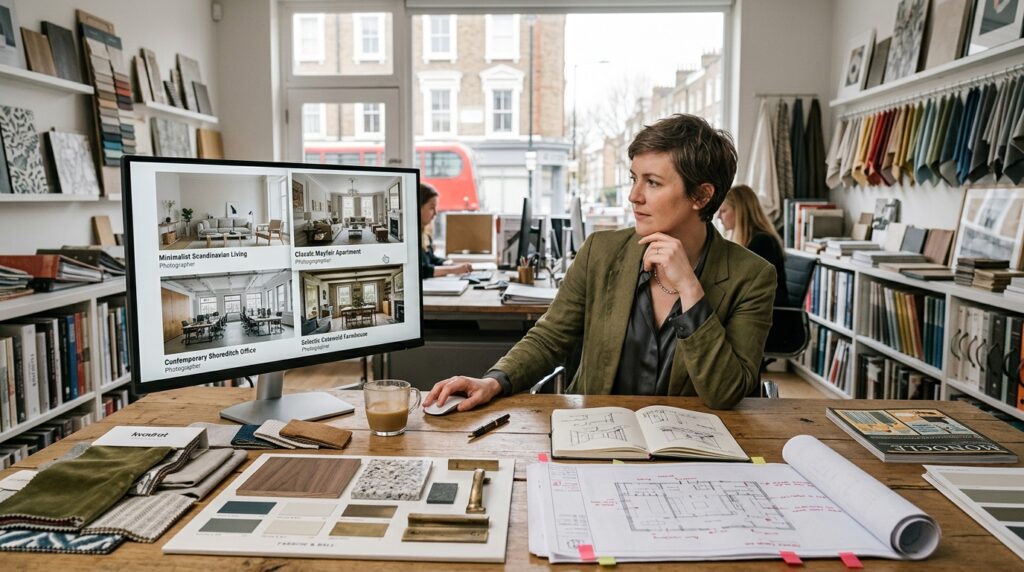
The table below summarizes the key considerations for matching an interior photographer in London to the most common project types encountered by architects, developers, hotel groups, designers, and commercial clients:
Project type | Key photography priorities | Portfolio to request | Typical London day rate |
Residential sales or lettings | Wide coverage, fast turnaround, accurate colour | Multiple full property sets, not selected highlights | 350 to 700 pounds |
Luxury residential development | Atmosphere, material quality, lifestyle aspiration | Comparable high-value residential projects | 800 to 2,000 pounds |
Architectural documentation | Spatial accuracy, perspective control, material rendering | Award submissions and design press credits | 900 to 2,000 pounds |
Hotel repositioning or launch | Brand atmosphere, experiential quality, OTA performance | Comparable hotel sector commissions | 1,000 to 2,500 pounds |
Restaurant or hospitality | Moody atmosphere, food-adjacent styling, pre-service precision | Restaurant editorial and brand campaigns | 800 to 1,800 pounds |
Retail or workspace | Brand alignment, product context, lifestyle integration | Commercial retail or commercial workplace projects | 900 to 2,000 pounds |
Commercial advertising | High production value, art direction, campaign alignment | Campaign credits and advertising portfolio | 1,500 to 4,000 pounds |
Day rate ranges above are approximate and reflect the London market in 2025 based on data from Hora Photography’s analysis of UK interior photography pricing (2025). [4] London rates typically sit 20 to 30 percent higher than equivalent work elsewhere in the UK. Rates do not include licensing fees for use beyond the agreed scope, which should be discussed and agreed in writing before a commission is confirmed.
How to Write a Brief That Gets the Images You Need
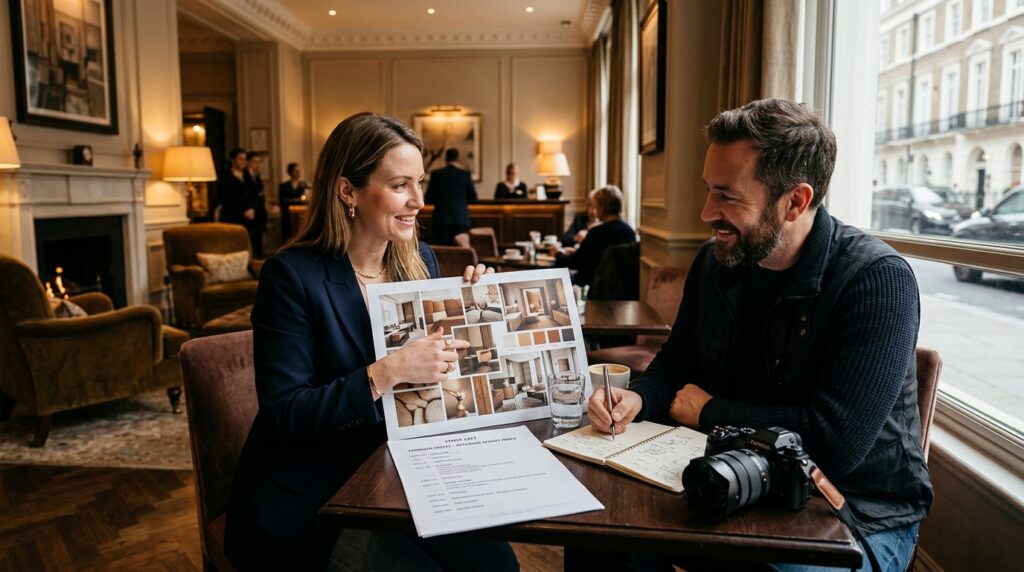
The quality of a brief directly determines the quality of images delivered. According to guidance published by Creative Review on commissioning photography, the key to commissioning great photography is finding a photographer who understands the vision, and the brief is the primary tool for communicating that vision. [5] A brief for an interior photographer in London should include the following elements:
Intended use and distribution channels
State clearly where the images will be used: a website, a hotel listing portal, a property brochure, press materials, social media, award submissions, or a combination of these. Each channel has different technical requirements for image dimensions and resolution, and different compositional requirements for how much negative space or specific framing may be needed. A photographer who knows the intended use from the start can make compositional decisions at the shoot stage that make the images more useful across every channel.
Priority spaces and secondary coverage
Identify the three to five spaces in the project that must be photographed to the highest possible standard and that represent the core of the commission. Then list the additional spaces that require coverage for completeness. This priority structure helps a photographer allocate their time and effort correctly across a shoot day, rather than spending equal time on spaces with very different commercial value.
Reference images and the look to avoid
Providing three to five reference images that communicate the visual quality and atmosphere you are looking for is significantly more effective than a written description of style. Equally useful is one or two examples of work that represents the look you want to avoid. Interior photography allows for considerable stylistic variation within the same quality tier, and being explicit about both ends of that spectrum helps a photographer understand exactly where in it your project should sit.
Licensing requirements
Agree the scope of image licensing before the shoot. Standard interior photography commissions typically include a licence for digital and print use by the commissioning client for a defined period, often three to five years. Additional licensing for use by third parties, such as the interior designer, architect, or contractor on the same project, typically requires an additional fee. If images will be used in advertising, the licensing structure is different again. Clarifying this before the commission is confirmed prevents disputes after delivery and ensures the photographer prices the commission correctly from the start.
Frequently Asked Questions
How do I find a specialist interior photographer in London for my sector?
The most reliable method is to identify interior photography you have seen and admired in the same sector as your project, and to trace it back to the photographer responsible. Press credits in design publications, Instagram account tags, and website credits are all reliable sources. Referrals from architects, interior designers, and hotel operators who have commissioned similar work are equally valuable, because they carry a professional track record rather than simply a polished online presence. When reviewing an unfamiliar photographer’s portfolio, ask specifically to see a full set of images from a single commission in your sector rather than a curated highlights selection from across multiple projects.
What is the typical cost of commissioning an interior photographer in London?
Interior photography day rates in London typically range from 350 pounds at the entry level for residential property photography to 2,500 pounds or above for specialist hotel and commercial advertising work. The day rate covers the photographer’s time on site and standard post-production but does not include licensing fees for extended or commercial use, expenses such as travel or parking, or any specialist equipment hire. For multi-day commissions or projects requiring significant preparation, additional pre-production costs may apply. The most effective way to understand the total cost of a commission is to request a detailed quote based on a written brief rather than asking for a standard day rate without context.
How long does an interior photography commission in London take?
A standard residential property shoot covering eight to twelve rooms typically takes three to four hours on site. A hotel bedroom category shoot covering multiple room types, suites, and public areas typically takes one to two full days. A restaurant commission photographed before service typically takes four to six hours. Architectural documentation of a completed building typically takes one to three days depending on the scale and complexity of the project. Post-production and image delivery typically follows within five to ten working days of the shoot for standard commissions, and within two to three working days for property clients with tighter listing deadlines. Confirm the expected delivery timeline in writing before the shoot.
Do I need to style and prepare the space before the shoot?
Yes, and this preparation is one of the most important factors determining the quality of the images. An interior photographer can compose, light, and capture a space with technical precision, but they cannot control the state of the space before they arrive. Surfaces should be clean and free from marks, fixtures should be in working order, all temporary or irrelevant objects should be removed, flowers and plants should be fresh if they are part of the space, and any soft furnishings should be steamed or pressed. For hotel photography, every room being photographed should be in perfect room-ready condition before the photographer arrives. Preparation time spent before the shoot produces better images than equivalent time spent attempting to correct problems during it.
What sectors does an interior photographer in London typically cover?
An interior photographer in London may work across residential properties, hotels and serviced apartments, restaurants and bars, retail environments, offices and workspaces, architectural projects, and advertising and lifestyle campaigns. Most established photographers in London have stronger experience in some sectors than others. Reviewing the portfolio for sector-specific experience relevant to your project, rather than assuming general interior photography competence transfers equally across all contexts, is the most important step in finding the right photographer for a specific commission. The most relevant portfolio evidence is always a directly comparable project: a hotel photographer’s hotel work, a restaurant photographer’s restaurant work, a residential photographer’s residential work.
The Right Interior Photographer in London for Your Project
London has one of the deepest pools of professional interior photography talent in Europe, which makes the evaluation process more important rather than less. The breadth of choice means that the difference between commissioning well and commissioning poorly is entirely within the control of the client. A clear brief, a portfolio review that prioritises sector-specific experience and consistent quality over headline images, and an honest conversation about licensing scope and delivery timelines will produce a commission that serves the project for years.
The financial case for commissioning correctly is straightforward. Professional interior photography generates measurable returns across every channel it is used in: more online views, faster sales, higher rates, stronger booking conversion, and more effective press coverage. The cost of a professional interior photography commission in London is a small fraction of the commercial value of the assets it produces.
To review interior photography produced across residential, hotel, restaurant, workspace, retail, architecture, and advertising projects in London, visit the portfolio sections of this site. For residential work, see the residential portfolio. For hospitality and hotel work, see the hotel portfolio. For restaurant and food and beverage, see the restaurant portfolio. To discuss a specific project brief or check availability, get in touch directly.
References
All external sources cited in this article are peer-reviewed studies or established industry sources.
- Yu J, et al. The effects of the aesthetics and composition of hotels’ digital photo images on online booking decisions. Humanities and Social Sciences Communications, Nature, 2023
- PhotoUp. 90 Plus Key Real Estate Photography Statistics and Trends for 2025. PhotoUp Industry Research, 2025
- Li Y, et al. Does the luxury hotel cover photo matter? Understanding the impact of picture value types on consumers’ behavioral intentions on OTAs. Annals of Tourism Research, Volume 115, ScienceDirect, 2025
- Hora Photography. How Much Does Interior Photography Cost in the UK? And What You’re Really Paying For. Hora Photography Blog, 2025
- Creative Review. How to Commission Great Photography. Creative Review, 2021