
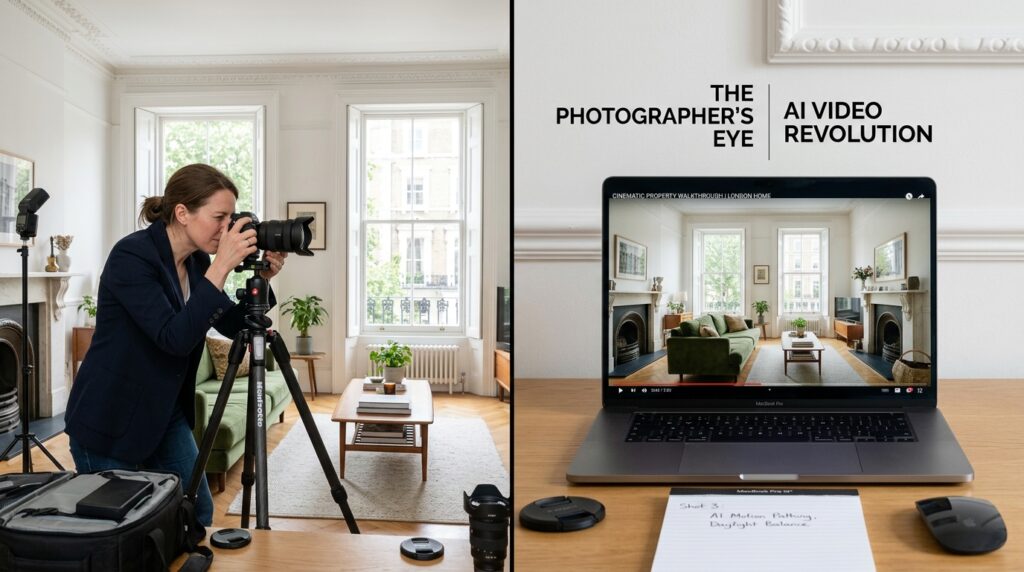
AI interior videos are now a mainstream tool in property marketing. What began as a niche technology used by a handful of early-adopting agencies has moved rapidly into the standard toolkit for developers, estate agents, hotel groups, and residential clients marketing high-value properties. The shift is not simply about novelty. It is being driven by a clear and measurable performance gap between listings that use video and those that do not, and by the arrival of AI tools that have lowered the cost and time required to produce video content from almost any set of still images.
This article explains what AI interior videos are, how they are produced, where they perform best, and where the limits of AI-generated content place professional interior photography in a stronger position than any automated system currently available. For property marketing teams, hotel groups, developers, and residential clients working in London, understanding that distinction is increasingly important.
What AI Interior Videos Are and How They Are Made
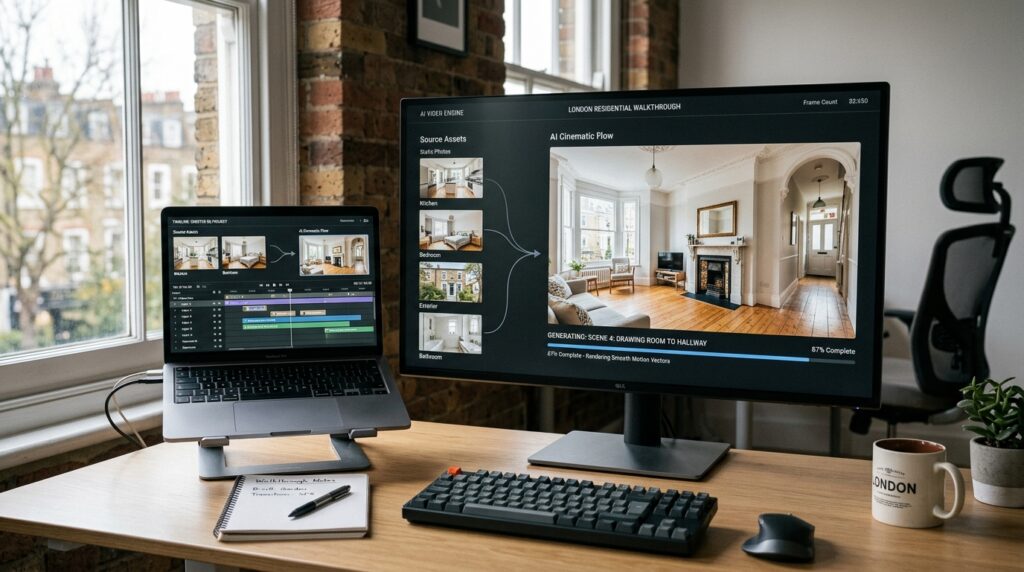
AI interior videos are cinematic video walkthroughs of a property produced using artificial intelligence rather than a video camera and production crew. The most common production methods fall into three categories.
Image-to-video AI tools
These tools take a series of still photographs, typically produced by a professional photographer, and use AI to animate them into a smooth video sequence. The AI predicts movement between frames, adds camera motion, applies transitions, and produces an output that reads as a continuous walkthrough of the space. Tools in this category include Runway ML, Kling AI, and Luma AI. The quality of the output depends almost entirely on the quality of the source photographs. High-resolution, professionally lit interior images produce significantly better AI video results than photographs taken on a smartphone.
3D scan to video pipelines
Systems such as Matterport capture a three-dimensional scan of a property and use AI to generate video walkthroughs directly from the digital twin data. Because the AI has a complete spatial model of the property to work from, it can produce more geometrically accurate movement than image-to-video tools working from flat photographs. These systems are used primarily for residential sales, commercial property, and hospitality, where a full spatial capture is already part of the marketing workflow.
Fully synthetic AI interior videos
A smaller but growing category involves AI generating an interior environment from a text prompt or a basic reference image, producing a video of a space that does not yet physically exist. This application is used primarily by property developers marketing off-plan residential schemes and by architects presenting concept designs to clients before construction begins. The output is not a representation of a real property but a visualisation of a proposed one.
Across all three categories, the defining characteristic of AI interior videos is that they remove the requirement for a video camera operator and production crew on site. The video is produced in post-production from existing visual assets, whether photographs, scans, or generative inputs
Why AI Interior Videos Are Changing Property Marketing Performance
The case for video in property marketing is well established by data. According to analysis compiled from NAR and industry sources by ReSimpli (2025), listings that include video receive 403 percent more enquiries than listings without video, and properties with professional video content sell up to 31 percent faster. [1]
Zillow’s internal listing performance data, reviewed independently by Reel-E.ai (2026), found that buyers who watch a listing video spend five to eight times longer on a listing page and are twice as likely to schedule a showing compared to buyers who view photographs only. [2] For London estate agents and developers working in competitive markets where multiple comparable properties are listed simultaneously, that engagement differential is a direct competitive advantage.
AI interior videos accelerate access to this advantage in two specific ways.
Speed to market
A traditional property video requires a videographer on site, a production day, post-production editing, colour grading, music, and final delivery. Total turnaround from shoot to published video typically runs from three to seven days. An AI interior video produced from existing professional photographs can be generated within hours of the photographs being delivered. For agents and developers under pressure to list quickly in competitive markets, this speed advantage is significant.
Cost per listing
A professionally produced property video with a videographer and post-production typically costs between 500 and 2,000 pounds per property depending on size, location, and production values. An AI interior video produced from existing photographs costs a fraction of that, often between 50 and 200 pounds per property depending on the platform and output quality required. For agents or developers managing high volumes of listings, this cost reduction changes the economics of video marketing entirely.
The consequence is that video content, which was previously reserved for premium or high-value listings due to cost and production time, can now be applied across a broader range of properties. Agents who have historically used video for only their most expensive listings can now use AI interior videos across an entire portfolio.
AI Interior Videos vs Professional Video Production: What Each Delivers
AI interior videos and professional video production serve overlapping but distinct purposes. The decision between them is not simply a cost calculation. It depends on the type of property, the marketing context, and what the video needs to communicate.
Factor | AI interior video | Professional video production |
Production cost | 50 to 200 pounds per property | 500 to 2,000 pounds per property |
Turnaround time | Hours from source photographs | 3 to 7 days from shoot to delivery |
Visual quality ceiling | Limited by source photograph quality | Unlimited with right crew and direction |
Camera movement control | AI-predicted, not fully controllable | Fully controlled by videographer |
Atmosphere and feel | Dependent on photography tone | Independently controlled on the day |
Narrative and pace | Algorithmic sequencing | Directed to a specific brief |
Best application | Volume listings, fast-turnaround marketing | Flagship properties, campaigns, hospitality |
Social media suitability | Strong for Reels, TikTok, Stories | Strong for all channels including broadcast |
Works without photography | No, requires strong source images | Yes, captures photography and video together |
The table above clarifies a point that is frequently misunderstood in discussions about AI interior videos: they are not a replacement for professional photography. They are a downstream application of it. The quality of an AI interior video is bounded absolutely by the quality of the photographs it is generated from. Poorly lit, small-format, or inaccurately colour-balanced photographs will produce poor AI video regardless of how sophisticated the AI tool is. The investment in professional interior photography is not made redundant by AI video. It is what makes AI video usable.
Where AI Interior Videos Perform Best in Property Marketing
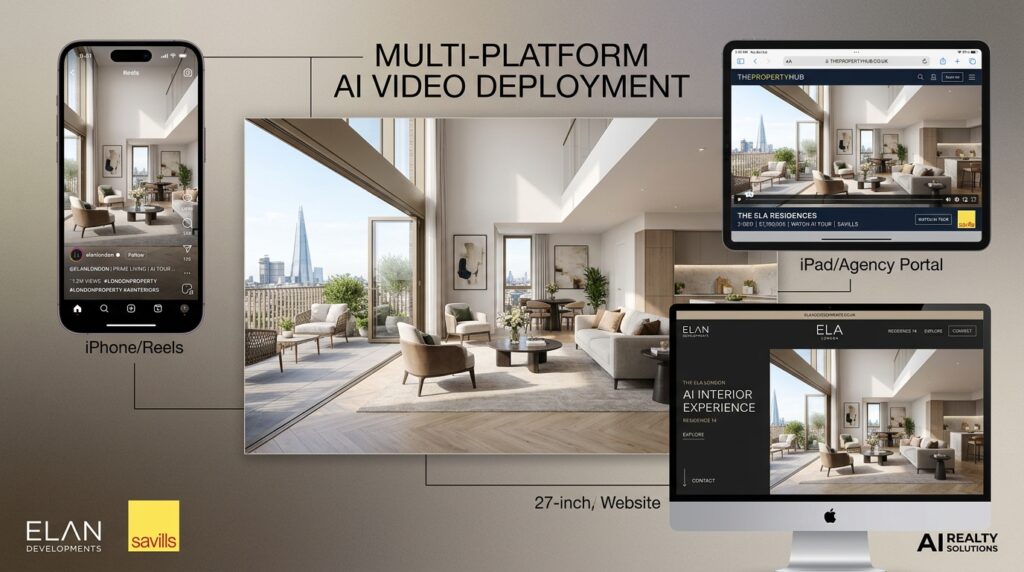
Residential sales at volume
Estate agents managing portfolios of ten or more active listings benefit most directly from AI interior videos. Applying video across an entire portfolio rather than only to selected properties raises the overall performance of the portfolio. According to the NAR 2024 Profile of Home Buyers and Sellers, 73 percent of homeowners say they are more likely to list with an agent who offers video marketing. [3] Offering AI interior video across all listings, rather than reserving video for premium properties only, is an increasingly effective differentiator in listing presentations.
New residential development and off-plan marketing
Property developers marketing residential schemes before or during construction use AI interior videos to show prospective buyers what completed apartments and houses will look and feel like. In this context, AI-generated video from rendered or CGI source images serves as a practical tool for securing pre-completion sales and generating enquiries for show homes and sales suites before they are built.
Social media and short-form video channels
Instagram Reels, TikTok, and YouTube Shorts reward short-form vertical video content with disproportionate organic reach compared to static image posts. AI interior videos are well-suited to these formats because they can be generated quickly in vertical aspect ratios and at durations of 15 to 60 seconds that match platform requirements. According to data cited in the ReSimpli real estate video analysis (2025), social media videos generate 1,200 percent more shares than images and text combined. [1] For London agents and developers with active social media marketing programmes, this reach differential justifies the production cost of AI interior videos across even modest-value listings.
Hotel and hospitality pre-booking content
Hotels, serviced apartments, and short-let properties benefit from AI interior video in the same way as residential listings. Research cited by 7CGI (2025) found that hotels which implemented virtual tour and video content reported a 16 percent increase in direct bookings compared to listings using photographs alone. [4] For hospitality properties in London competing with listing photographs on Booking.com and Google Hotels, an AI interior video that communicates the atmosphere of a room is a conversion tool rather than simply a marketing asset.
Where Professional Interior Photography Leads and AI Video Cannot Replace It
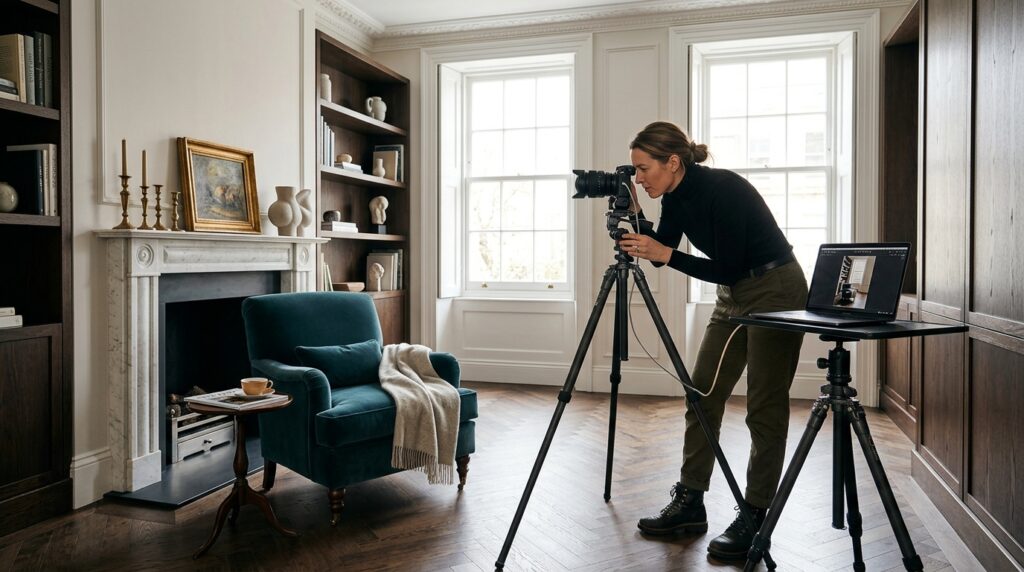
AI interior videos are only as strong as the photographs they are built from. This is the most important practical point for any property marketing team or client commissioning visual content in 2025. The AI tool is the production mechanism. The professional photographer is the creative director, the technical specialist, and the quality control.
Lighting that cannot be replicated in post-production
Professional interior photography controls light at the point of capture. A skilled interior photographer balances natural window light with supplementary flash or continuous lighting to produce images where every surface is correctly exposed, where the view through windows is visible rather than blown out, and where the atmosphere of the space is accurately communicated. AI video tools working from photographs cannot retroactively correct for poor lighting decisions made at the time of capture. If the source photograph has blown highlights, flat light, or incorrect colour balance, the AI video inherits those problems at scale across every frame.
Composition that communicates the right story about a property
An experienced interior photographer makes specific decisions about angle, height, lens choice, and depth of field that determine what a room communicates about itself. A wide-angle lens at a low position makes a room appear larger. A standard lens at eye height is more truthful about scale. A tight crop on an architectural detail communicates quality. An AI tool generating video from a collection of photographs works with the compositional decisions that were made at the time of shooting. It cannot create better compositions than the photographer produced.
Styling and art direction
Professional interior photographers work with or alongside stylists to ensure that each room is presented in its most compelling form before a single frame is captured. This includes furniture arrangement, soft furnishing choices, the placement of objects and artwork, the handling of natural light sources, and the removal of elements that weaken the composition. No AI tool currently operates at the physical level required to prepare a space for photography. The styling work happens before the camera arrives, and it is this preparation that determines whether the finished photographs, and by extension the AI video produced from them, represent the property accurately and attractively.
Frequently Asked Questions
Do AI interior videos require professional photographs to work well?
Yes, in almost all practical applications. AI interior video tools that work by animating still photographs are bounded by the quality of the source images. High-resolution, professionally lit photographs with accurate colour balance and well-considered composition produce significantly better AI video output than photographs taken on a phone or with a basic camera. Developers and agents who commission professional interior photography and then use those images as source material for AI video production are effectively getting two distinct outputs from one shoot investment. The professional photographs serve their usual function across portals, brochures, and digital marketing, while the AI video serves as an additional asset for social media, email marketing, and listing pages.
Can AI interior videos be used for luxury property marketing in London?
AI interior videos are used across a wide range of London property types and price points, including luxury and prime central London residential. At the top end of the market, the video is typically used alongside, not instead of, professionally produced property film. The AI video serves short-form social media and portal channels where speed and volume of content matter, while the professionally produced film serves the flagship property website, press materials, and any broadcast or out-of-home advertising. For prime London residential properties above approximately two million pounds, using only AI video without a professionally produced film risks communicating less ambition than the property warrants.
How long does it take to produce an AI interior video from photographs?
Generation time depends on the platform used, the length of the video required, and the processing queue at the time of production. Most AI interior video tools produce a one-minute video from ten to fifteen source photographs within thirty minutes to two hours of submission. Review and approval of the output, any revision requests, and final formatting for the intended channels typically adds between two and four hours. From professional photographs delivered by the photographer, an AI interior video can realistically be published on a property listing within the same working day.
What is the difference between an AI interior video and a virtual tour?
A virtual tour is an interactive experience where the viewer controls the direction of movement through a space, typically using a Matterport-style 3D scan or a series of 360-degree panoramic photographs linked together. An AI interior video is a linear video that plays like a conventional film, with camera movement determined by the AI rather than the viewer. Virtual tours offer more exploration depth and are better suited to buyers who want to investigate specific rooms in detail. AI interior videos are better suited to social media, email marketing, and listing portal contexts where a linear, non-interactive video performs more consistently across different devices and platforms.
Will AI interior videos replace professional interior photography?
No. The relationship between professional interior photography and AI interior videos is collaborative rather than competitive. AI video is a production tool that operates on the output of professional photography. It adds a video format to the visual assets produced from a professional shoot, it does not substitute for the skill, judgment, or technical capability of the photographer. What AI video does change is the expectation that video content is expensive and time-consuming to produce. As AI tools mature, the expectation that any property has both photographic and video content as standard will increase. This raises the baseline requirement for visual marketing rather than reducing the value of the photography that underpins it.
Professional Photography Is Still Where Property Marketing Starts
AI interior videos have changed the economics and speed of video content in property marketing. They have brought video within reach of listings and budgets that previously could not justify the cost of professional video production. They have compressed the time between a property going live for photography and that property having video content available for every digital channel. These are genuine advantages that are changing how London estate agents, developers, and hospitality clients approach their marketing campaigns.
The foundation, however, has not changed. AI interior videos are as strong as the photographs they are built from. A property that is photographed correctly, with the right light, the right composition, and the right preparation, produces AI video that represents it accurately and attractively. A property that is photographed quickly or poorly produces AI video that inherits and amplifies every weakness in the source images.
To discuss how professional interior photography can serve as the foundation for both still and AI video content across your property marketing campaign, visit the residential portfolio, review the work produced for the hotel and hospitality sector, or get in touch directly to discuss a specific project brief.
References
All external sources cited in this article are established industry research and analysis sources.
- ReSimpli. 55 Plus Real Estate Video Statistics: Market Game-Changer 2025. ReSimpli Real Estate Marketing Research, 2025
- Reel-E.ai. Do Video Listings Sell Faster? What the Data Actually Shows. Reel-E.ai Industry Analysis, 2026
- National Association of Realtors. 2024 Profile of Home Buyers and Sellers: Video Marketing Statistics. NAR Research and Statistics, 2024
4. 7CGI Limited. VR Real Estate: How Virtual Tours Are Transforming Property Marketing in 2025. 7CGI Blog, 2025